
Best Time to See Northern Lights in Levi
Tip: a short walk from our apartments you'll find dark spots where the aurora shows up best — see accommodations in Levi.
Tip: stay walking distance from restaurants and lifts — see free apartments in Levi centre.
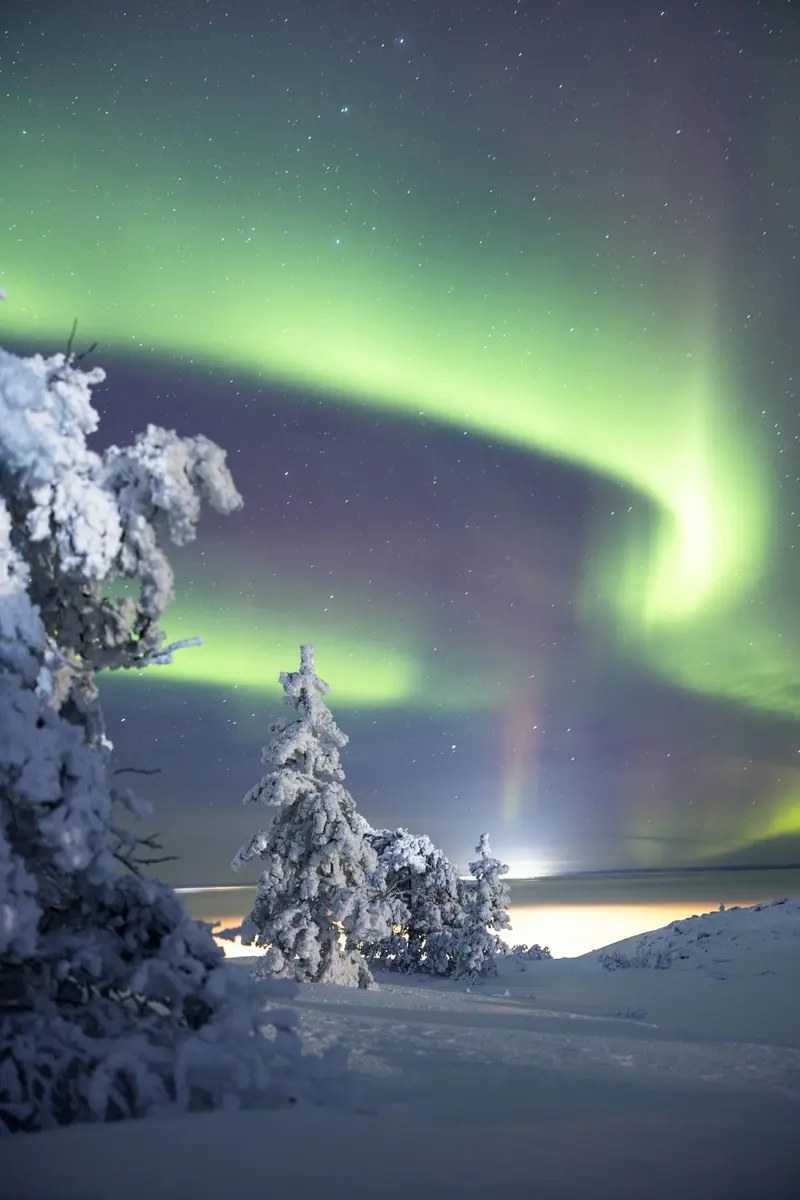
Northern lights arching over snow-laden trees in Levi — winter's magical light show. Photo: Janosch Diggelmann
Aurora Season in Levi at a Glance
The northern lights season in Levi lasts from approximately late August to early April — whenever nights are dark enough. During summer, the midnight sun prevents aurora viewing entirely: from May to July, the sun doesn't set at all or barely dips below the horizon. The sun is equally active year-round, but during light nights the aurora is invisible to the naked eye.
This makes Levi a special place: a long aurora season (7–8 months) combined with a location north of the Arctic Circle (67.8° N) means there are dozens of potential viewing nights per year. Levi sits beneath the aurora oval — the zone where northern lights occur most frequently.
Best Months
September: The season begins in earnest around mid-September. Nights darken rapidly and the first clear aurora sightings are typically made during the third week. September's special advantage is the ruska (autumn foliage) season — seeing northern lights above a landscape painted in gold and red is unforgettable. Weather is often still clear and pleasantly cool.
October: An excellent month. Nights are already long (16+ hours of darkness) and weather is often clear before the winter cloud season begins. October is also a quiet and affordable travel period — few tourists but excellent aurora possibilities.
November: Nights grow even longer and the polar night approaches. However, cloudiness increases in November, which is the main challenge. On clear nights, conditions are excellent — darkness is not an issue.
December: Polar night — in Levi the sun doesn't rise at all around mid-December. The longest nights theoretically mean the most opportunities, but December cloud cover in Lapland is at its highest. On a clear frosty night, the display can be breathtaking.
January: Based on experience, the single best month. Nights are still very long, but January often brings a clear cold spell lasting weeks. Cold air typically means fewer clouds. January is also quiet and affordable.
February: Excellent. Nights are still long enough (darkness from 5 PM to 8 AM) and weather is often clear and cold. The ski holiday season brings more visitors, but this doesn't affect aurora visibility — the sky is the same for everyone.
March: Still possible in early March. Nights shorten rapidly as the month progresses and by month's end nights are too light for faint aurora. The last good opportunities are usually in the first two weeks of March.
Best Time of Night
Northern lights are most commonly seen between 9 PM and 1 AM, but can occur as soon as it gets dark and before dawn. Statistically, the most active time is around 10 PM to midnight local time, but this varies significantly from night to night.
The best strategy is simple: check the forecast in the evening and go outside when the KP index is elevated (3+). You don't need to stay up all night — at their best, aurora displays last only 15–30 minutes at a time, though during strong storms the sky can remain active for hours.
Tip: Install a northern lights alert app (e.g., My Aurora Forecast) on your phone to receive notifications when activity rises. This way you can sleep peacefully and wake only when conditions are promising.
The Importance of Darkness
Northern lights occur in the atmosphere year-round — they don't disappear in summer. But they're only visible to the eye against a dark sky. In Levi, this practically means:
• Not visible: May–July (midnight sun — sun doesn't set)
• Weakly visible: Early August and late March (nights too light for faint aurora)
• Best visibility: September–February (long dark nights, 14–24 hours of darkness)
The polar night period (early December to mid-January) offers the longest dark periods and theoretically the most viewing time. The downside is that cloud cover is often at its highest during this exact period.
Cloud Cover — The Biggest Enemy
Northern lights occur at 100–300 kilometres altitude in the atmosphere. If the sky is cloudy, you won't see them — even if they're shining strongly up there. Cloud cover is by far the most common reason people don't see aurora on a given night in Levi.
Levi's continental climate produces more clear nights than the coastal regions of Norway or Iceland — this is one of Levi's significant advantages. But cloudiness is still a daily reality, especially in November–December.
Practical tip: Always check the cloud forecast before heading outside. The Finnish Meteorological Institute (ilmatieteenlaitos.fi) and yr.no offer precise hour-by-hour cloud forecasts. Sometimes the cloud layer is localised — a 20 km drive may be enough to reach a clearer area.
Solar Activity Cycle
The sun goes through approximately 11-year activity cycles. At the cycle's peak, the sun releases more and stronger particle bursts (CMEs), which cause stronger aurora displays. The years 2024–2026 are near the peak of the current cycle (Solar Cycle 25), and exceptionally strong northern lights have been seen at record frequencies — even in Central Europe.
However, this doesn't mean you won't see aurora in other years. Levi is north of the Arctic Circle, beneath the aurora oval, where northern lights occur dozens of times annually regardless of the solar cycle phase. The activity peak only increases the probability of strong storms — weak and moderate aurora can be seen every winter.
Stay in Levi — dark aurora spots are a short walk from our apartments.
Browse accommodation →Frequently Asked Questions
The information on this page is intended as general tips and inspiration for planning your Levi holiday. Availability, prices, opening hours and business details may change without notice. We recommend verifying current information directly with service providers before making any bookings. Leville.net is not responsible for third-party services or any changes to their offerings.